Cadence is a performance hydration brand built on the belief that water isn’t enough. Its salt-forward formulas were made for runners, and runners made it one of the fastest-growing names in the category. Now the brand is going after something bigger: a $100M run rate, and a customer who has never laced up a pair of trainers. Getting there means testing new messages, products, and concepts quickly, and knowing which ones deserve to scale.
Cadence’s growth team already moves at a pace their competitors can't keep up with. Jurni lets the post-click experience keep up. In 8 weeks, the team has generated 32 Agentic Landing Experiences, each in minutes, getting them live while the ad is still fresh and reaching data-backed conclusions in days rather than weeks.
The challenge
Cadence’s PDP was built to serve a broad customer base, and it did that job well. As Cadence expanded its product line beyond runners, its paid strategy got sharper, reaching new audiences, from poor sleepers and stressed professionals to women in menopause and new parents. Each of those shoppers clicks for a different reason, and Cadence wanted the shopping journey to pick up where the ad left off.
Doing that for one campaign is a project. Doing it for every concept is a different scale entirely. Cadence set a target of 100 net new ad concepts a month, and each one needed a destination built around its message, live while the ad was still fresh, so the team could see which ideas truly worked.
The goal:
Give every new audience a shopping journey of its own, live at the speed of the creative, and let the data decide which ones to scale.
The experiences that drove performance
A new audience: busy & tired
This shopper isn't training for a marathon, they're just busy, tired, and out of hours. The problem isn't how long they sleep, but how well.
By the time Cadence launched this campaign, five weeks of testing had already shown which buy boxes, offers, and urgency cues worked, so each experience started from proven winners rather than a blank page. The team generated three Agentic Landing Experiences to test different ways of converting them. In three weeks, they earned 57% more revenue per session than Cadence's other landing experiences.

Advertorial: for shoppers new to the idea
The sleep-quality argument needs room to land. The advertorial walks colder shoppers through why rest breaks down overnight and where hydration fits before it asks them to buy.
Why it works:
A new reason to buy is also a new belief. Shoppers who have never connected sleep with hydration rarely convert on a product claim alone. Education turns the idea into something they agree with first, so the purchase becomes the natural next step rather than a leap.
Comparison: for shoppers with a nightly habit worth swapping
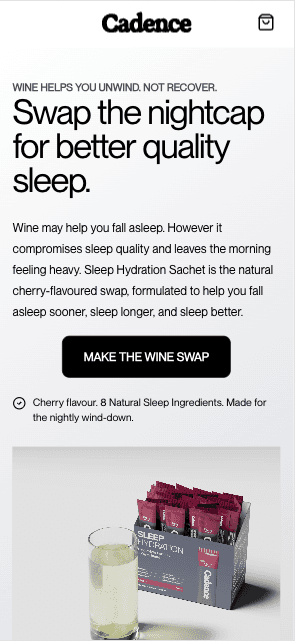
This landing experience speaks to a familiar ritual: the glass of wine before bed. Cadence offers a swap, a nightcap of sleep hydration, that helps the shopper wind down and wake up feeling good rather than groggy. It is a narrow, specific story, and it carries from the ad all the way through to checkout.
Why it works:
Shoppers convert faster when they recognise themselves in the first screen. Wine Swap doesn't argue the science first. It names a moment many of these shoppers already experience every night and offers a better version of it. The more specific the moment, the shorter the distance from click to conversion.

Product landing page: for shoppers ready to buy
For shoppers ready to buy, the question isn't whether, but how much. Cadence uses its direct response to test that purchase structure. Offering multibuy packs instead of a single product lifted revenue per session 65%, as shoppers chose larger orders at the same conversion rate. From there, the team layered on a subscription frequency selector, a new buy box, and a countdown, keeping only what the data supported.
Why it works:
These shoppers are the most likely to buy, so the bigger opportunity is often order value rather than persuasion. Changes to the offer and purchase structure move revenue directly. Jurni captures performance data on every variant. Each test tells the team what to try next so the experience keeps compounding.
Looking forward
The busy-and-tired audience started as one territory in one sprint. It’s now the template for every new audience Cadence goes after.
The bigger shift is in how Cadence decides what to build. Each sprint now produces performance data on audiences, offers, and layouts, and Jurni turns that data into its next recommendation. Cadence started with runners. With every sprint, it’s getting faster at finding who comes next, and that speed is what turns a $100M target into a run rate.